

 42 Wierda Road West,

 +27 11 305 7300


Annual reporting is evolving.
For many organisations, the integrated report has traditionally been viewed as a compliance-driven document – a static PDF produced once a year and distributed to a limited audience. But stakeholder expectations are changing rapidly, and so is the digital environment in which organisations communicate.
Today, investors, regulators, employees, analysts and broader stakeholders expect information that is accessible, engaging and easy to navigate. At the same time, AI-driven search and large language models (LLMs) are reshaping how information is discovered and interpreted online.
This shift is creating a new opportunity for organisations to rethink reporting – not simply as a document, but as an interactive stakeholder engagement platform.
At Ince we have recently partnered with organisations that are embracing this evolution through digital integrated reporting.
Investing in the future of investor engagement
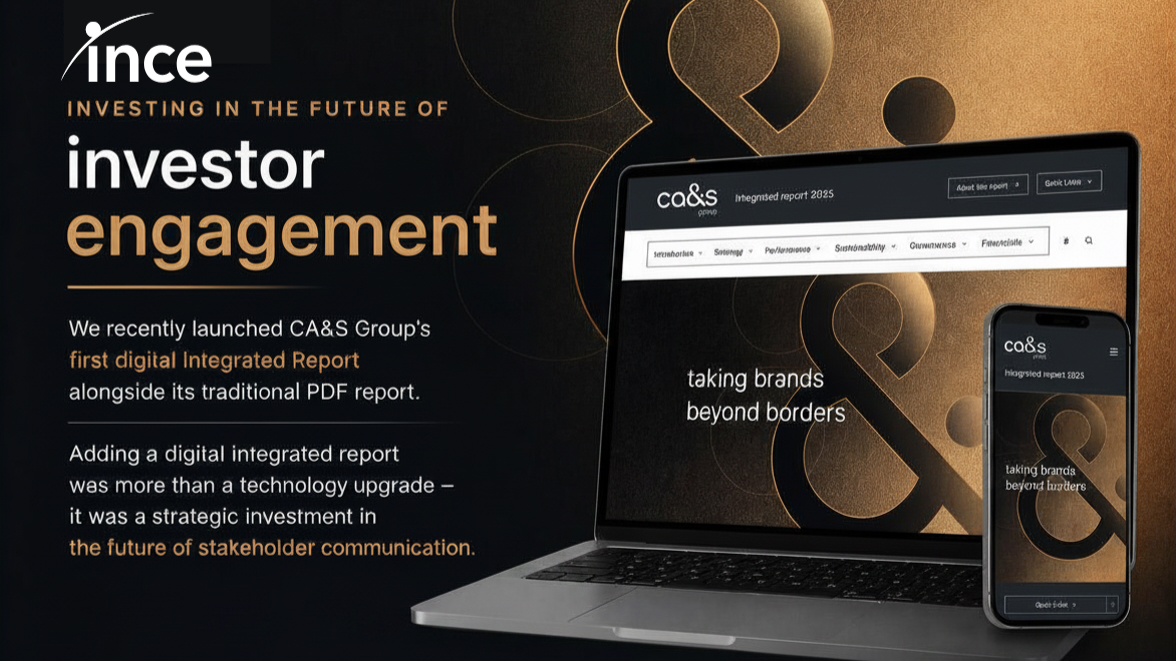
One example is CA&S Group, where we recently launched the organisation’s first digital Integrated Report alongside its traditional PDF report.
The move to a digital reporting environment was about far more than technology. It represented a strategic investment in the future of stakeholder communication and investor engagement.
A fully digital HTML report creates opportunities that traditional PDFs simply cannot provide.
Why digital reporting matters
AI tools and LLMs increasingly prioritise accessible, structured and machine-readable content. HTML-based reporting enables information to be more effectively indexed, interpreted and surfaced by AI-powered search tools.
Digital reporting environments also introduce an important new capability: analytics. Unlike static PDFs, online reports provide organisations with valuable insights into stakeholder behaviour, including:
Which sections attract the most attention
- How users navigate through the report
- Which content drives engagement
- Where stakeholders spend the most time
- Which devices stakeholders use to access information
These insights help organisations continuously refine and improve communication strategies over time.
Enhancing the stakeholder experience
The CA&S Group report was designed to create a more intuitive, engaging and accessible experience for stakeholders through features such as:
- An engaging landing page with a clear report overview
- Interactive graphs and tables
- An interactive risk heat map
- Compact and focused content presentation
- Effective navigational tools
- Hyperlinked access to supporting information
- A seamless mobile and desktop experience
- Structured data that improves AI accessibility
Importantly, the report establishes a strong foundation for future digital engagement opportunities – from expanded multimedia integration to deeper AI-aligned reporting structures.
Transforming stakeholder engagement – digitally
Another powerful example of digital reporting innovation is Cotlands.
Last year, Cotlands became the first NPO organisation to produce a fully digital online integrated report – a pioneering step within the non-profit sector.
This transition demonstrated how digital reporting can fundamentally transform stakeholder engagement by making complex information more accessible, engaging and human-centred.
The report’s impact was recognised by judges at the Chartered Governance Institute of Southern Africa (CGISA)JSE Integrated Reporting Awards, who commended the digital approach for its accessibility, readability and authenticity.
Why the digital approach stood out
The judges highlighted several strengths of the online reporting environment:
- Innovative and accessible format: the web-based platform sets a powerful precedent for the non-profit sector, prioritising accessibility and connectivity.
- Enhanced Readability: features like interactive risk heat maps and intuitive navigation keys transform complex data into clear, understandable and accessible insights
- Authentic Storytelling: the use of multimedia and video messages adds a personable, warm touch that static PDFs simply cannot match.
- Visual appeal: creating a well-organised and easy-to-navigate engagement experience
- Uncompromising Transparency: clear indicators for assured data points reinforce trust and accountability.As noted by the judges:
“The report’s innovative shift… offers an engaging and authentic experience that aligns well with the IR Framework principles of conciseness and connectivity.”
The inclusion of multimedia content and video messaging created a more personal and engaging reporting experience — something static PDF reports often struggle to achieve.
The future of integrated reporting
Digital engagement is becoming an essential component of future-focused stakeholder communication.
As organisations continue to navigate increasingly digital stakeholder environments, online integrated reports provide a meaningful way to:
- Improve accessibility
- Strengthen transparency
- Increase stakeholder engagement
- Enhance readability
- Support AI discoverability
- Generate actionable communication insights
Most importantly, digital reports transform reporting from a once-a-year publishing exercise into an ongoing engagement opportunity.
The future of reporting is not simply about presenting information digitally. It is about creating connected, interactive and intelligent communication experiences that better serve stakeholders.
And this evolution is only beginning.